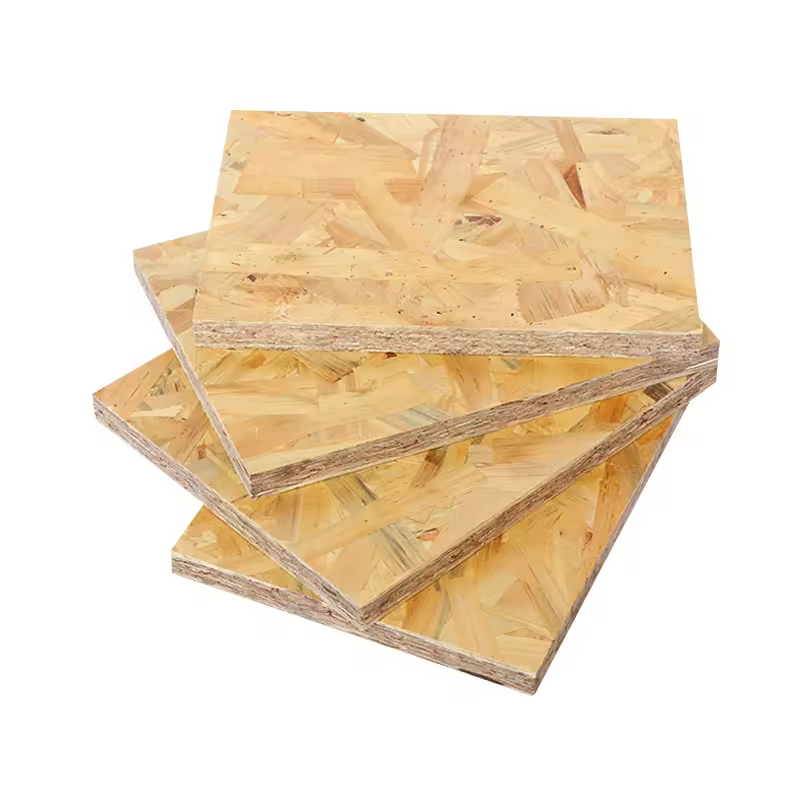
The difference between moisture-resistant particleboard and regular particleboard
Moisture-resistant particleboard (also known as moisture-resistant board, micro-particle board, or particleboard) is a type of engineered wood product made by adding moisture-resistant particles (such as paraffin emulsion and waterproofing agents) to ordinary particleboard to enhance its moisture resistance. It is suitable for humid environments such as kitchens and bathrooms.

Features of moisture-resistant particleboard:
Significantly Improved Moisture Resistance
– Ordinary particleboard typically has a 24-hour thickness expansion rate of >18% after water absorption, while P6 type moisture-resistant board (national standard GB/T 4897-2015) requires ≤14%, with some high-end products reaching <5%.
– Moisture-resistant particles form a moisture barrier layer inside the board, effectively slowing down moisture penetration, but it is not completely waterproof; it still needs to be wiped dry promptly after contact with water.
– Good Mechanical Properties
The static bending strength of moisture-resistant particleboard can reach ≥110 MPa, and the modulus of elasticity ≥3430 MPa (some products far exceed the standard).
– Strong nail-holding power and superior lateral load-bearing capacity compared to ordinary particleboard, making it suitable for manufacturing heavy-duty furniture such as cabinets and bathroom vanities.
– High structural stability
The internal particles of moisture-resistant particleboard have a cross-laid structure, resulting in uniform properties in all directions and strong resistance to deformation.
– Oriented Strand Board (OSB) further enhances dimensional stability, with minimal difference in longitudinal and transverse strength.
– Outstanding environmental friendliness (high-end products)
– Some moisture-resistant boards use formaldehyde-free adhesives (such as MDI and formaldehyde-free cyanate ester adhesives), achieving formaldehyde emissions at ENF level (≤ 0.05 mg/m³) or meeting F4 star standards.
– Obtained international formaldehyde-free certifications such as EPA-NAF and CARB-NAF.
– Smooth surface with rich finishes
Can be finished with melamine-impregnated paper, wood veneer, PVC lamination, etc., presenting various effects such as glossy, textured, and embossed surfaces.
Applications of Moisture-Resistant Particleboard:
– Kitchen cabinets, bathroom vanities, laundry room furniture
– Semi-open balconies, basements, waterfront tea rooms, home bar counters
– Bedroom and living room cabinets in homes in humid areas
The core difference between moisture-resistant particleboard and ordinary particleboard lies in its moisture-resistant performance, mainly reflected in the additives in the substrate, water absorption and swelling rate, applicable environment, and environmental protection indicators.

Main Differences between moisture-resistant particleboard and ordinary particleboard
– Addition of Moisture-Resistant Particles
Moisture-resistant particleboard incorporates moisture-resistant particles (such as copper sulfate) during the production process, significantly reducing its swelling upon contact with water; ordinary particleboard does not contain such additives.
– 24-Hour Water Absorption Thickness Expansion Rate
– Ordinary Particleboard: Typically higher than 18% (no national standard limit specified, but prone to noticeable deformation in actual use)
– Moisture-resistant Particleboard (P6 type): According to GB/T 4897-2015 standard, ≤14%; high-quality products can be as low as <5% (e.g., Daya High Moisture-resistant Board)
– Applicable Environment
– Ordinary Particleboard: Suitable for dry environments (e.g., wardrobes, bookshelves)
– Moisture-resistant Particleboard: Suitable for damp areas such as kitchens, bathrooms, and shower cabinets
– Environmental Protection and Adhesives
Moisture-resistant particleboard more often uses formaldehyde-free adhesives (e.g., MDI or cyanate ester adhesives), with some products achieving EPA-NAF, CARB-NAF, or F4 star environmental certifications; ordinary particleboard mostly uses urea-formaldehyde adhesives, resulting in higher formaldehyde release.
– Appearance Identification
Moisture-resistant particleboard substrate is often green (due to copper sulfate content), but some unscrupulous merchants use pigments to dye it. Authenticity can be verified through a water immersion test: genuine moisture-resistant boards have a significantly lower expansion rate than ordinary boards.
Performance and Usage Recommendations
– Nail holding power and load-bearing capacity: Similar to ordinary boards, both superior to MDF.
– Edge sealing requirements: Moisture-resistant boards still require proper edge sealing. Any detachment must be repaired promptly, otherwise moisture can still penetrate.
– Purchase tips: Look for the P6 marking and check the 24-hour water absorption expansion rate test report; avoid judging solely by color.