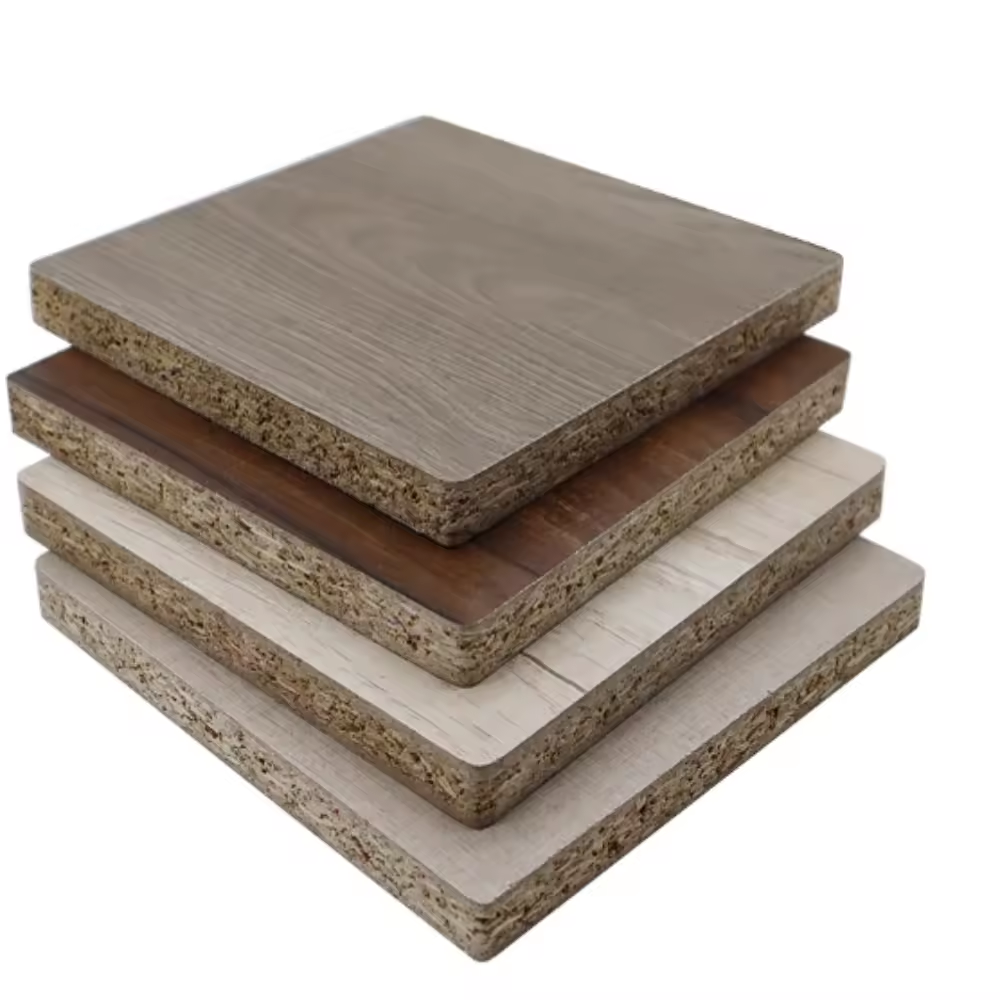
Chipboard vs. MDF: A Comprehensive Cost-Benefit Analysis for Furniture Manufacturers
Chipboard vs. MDF: Particleboard and MDF are two commonly used engineered wood products in furniture manufacturing. Each material has its own characteristics, and we’ll discuss which is suitable for which situation.

Particleboard (PB) wins out due to its low raw material cost, high structural stability, and nail-holding power, making it suitable for mass production of cabinets. Medium-density fiberboard (MDF) excels in surface workability and sculpting flexibility, but is more expensive than particleboard and is primarily used for door panels and decorative components. Using both together can maximize overall cost-effectiveness.
Chipboard vs. MDF: Material Costs:
Raw Materials and Manufacturing Costs: Particleboard uses wood chips/branches, has a relatively simple process, and lower overall cost. MDF requires deep fiberization of wood, resulting in higher energy consumption and adhesive usage, and is typically 30%-50% more expensive than particleboard for the same specifications.
1. Raw Materials and Processes: Chipboard uses wood chips/shavings, and the pressing process is relatively simple; MDF requires grinding wood into fibers, resulting in high temperature and pressure, high energy consumption, and typically larger amounts of adhesive, thus increasing the basic cost.
2. Processing Losses and Utilization: Processing loss and efficiency: Particleboard is prone to edge chipping during cutting, requiring sophisticated edge banding equipment, but the cutting speed is fast; MDF has a smooth surface that requires no secondary sanding, making it suitable for complex CNC shapes, but it generates more dust, causes faster tool wear, and these hidden processing costs must be factored in.
3. Environmental Grade Premium: Both types of boards increase in cost when reaching ENF/E0 grades, but MDF has a higher base cost due to its larger amount of adhesive used. Formaldehyde-free MDF is significantly more expensive than equivalent Chipboard.

Chipboard vs. MDF, Physical Properties:
Differences in Physical Properties: Particleboard has strong nail-holding power, good moisture resistance (especially moisture-resistant chipboard), and moderate bending strength, making it suitable for load-bearing structures; MDF has a uniform and fine structure, high bending strength, and is easy to mill and carve, but it swells easily when exposed to water, and its nail-holding power decreases rapidly after repeated disassembly and reassembly.
1. Density and Structure: MDF density is typically 0.65–0.80 g/cm³, with homogeneous distribution of wood fibers; Chipboard density is approximately 0.55–0.75 g/cm³, composed of irregularly shaped wood chips/particles pressed together, with internal voids.
2. Bending Strength (MOR) and Stiffness (MOE): In dry environments, MDF has significantly higher static bending strength (approximately 40–48 MPa vs. Chipboard 20–22 MPa), while their stiffness is similar; in high humidity environments (85% RH), the performance of both decreases, but Chipboard shows a more severe decline.
3. Water Absorption and Dimensional Stability: Chipboard has a higher thickness expansion rate when absorbing water than MDF, making it prone to bulging and deformation when exposed to moisture. While MDF is also susceptible to water damage, its tighter fiber bonding results in slightly better dimensional stability under short-term humidity fluctuations.
4. Nail Holding Power and Machinability: MDF has an extremely smooth surface, suitable for engraving, milling, and painting, but repeated screwing can cause nails to loosen. Chipboard’s coarse grain provides better initial nail holding power, but it cannot be used for complex shapes, and its edges are prone to chipping.
5. Weight and Load Capacity: At the same thickness, MDF is slightly heavier, and its lateral load-bearing capacity and impact resistance are superior to ordinary chipboard. Chipboard is often used for shelves or substrates and is not suitable for large-span load-bearing components.

Chipboard vs. MDF, Application Scenarios:
Application Scenarios: Particleboard dominates cabinet frames, shelves, and drawer boxes (accounting for over 60% of custom cabinet base materials); MDF monopolizes milled door panels, painted panels, and decorative moldings, and is rarely used in damp areas or large-span load-bearing components.
1. Particleboard is the core base material for panel furniture and whole-house customization, mainly used in cabinet structures, door panels, tabletops, and back panels. Its market dominance stems from its dimensional stability, ease of surface finishing, and high cost-effectiveness.
– Cabinet Structure: The main frame and shelves of wardrobes, cabinets, and bookcases (largest proportion, due to good nail-holding power and resistance to deformation);
– Surface Finish Components: Made with melamine-impregnated paper (melamine particle board), PVC, or wood veneer (wood veneer particleboard), forming door panels, countertops, and tabletops, balancing aesthetics and wear resistance;
– Auxiliary Structural Components: Used for furniture back panels, drawer bottoms (often using thin boards), and internal partitions;
– Special Functional Areas: Moisture-resistant particleboard with added moisture-proof agents is used in cabinet manufacturing for humid environments such as kitchens and bathrooms.
2. MDF (Medium-density Fiberboard) is primarily used in furniture manufacturing for non-load-bearing components requiring complex shapes, fine carvings, and high-flatness finishes. It is the preferred substrate for painted door panels, vacuum-formed door panels, and decorative cabinets.
– Shaped Door Panels and Decorative Components: Best suited for making European/French style carved door panels, vacuum-formed doors, and decorative cabinets, as its fine fibers can withstand complex machining processes such as milling and routing without chipping.
– Surface Coating Substrate: An ideal base for “mixed oil finishes” (covering wood grain and solid color paint), offering a smooth surface without texture interference, strong adhesion, and suitability for high-end lacquered furniture.
– Laminate Flooring and Veneer Substrate: Widely used as the core layer of laminate flooring and the bottom layer of veneer in some panel furniture, providing dimensional stability and flatness.
– Auxiliary Structural Components: Used for drawer bottoms, back panels, speaker enclosures, vehicle interior panels, and interior partitions—non-primary load-bearing parts.
Chipboard vs. MDF: Procurement Considerations:
1. Purely Cost-Sensitive Projects (e.g., rental properties, fast-moving consumer furniture): Use high-quality moisture-resistant particleboard throughout the project, sacrificing some design flexibility for the lowest BOM cost and fastest delivery, avoiding the high unit price and moisture risks of MDF.
2. High-Premium Custom Projects (e.g., high-end whole-house customization): Adopt a hybrid strategy of “particleboard cabinets + MDF door panels”. 3. **Special Environmental Considerations:** Ordinary MDF is strictly prohibited in damp areas such as kitchens, bathrooms, and balconies; moisture-resistant particleboard or OSB must be used. For dry bedrooms requiring extensive carvings, MDF has a lower scrap rate than milled particleboard.
4. Environmental Compliance Costs: Both can achieve ENF standards (≤0.025mg/m³), but formaldehyde-free (MDI glue) MDF is significantly more expensive than equivalent particleboard. The choice should be based on the customer’s willingness to accept an environmental premium.
5. Hidden Losses: MDF processing dust leads to high investment in dust removal equipment, and the edges have a high risk of swelling due to water absorption. If the edge banding is substandard, after-sales maintenance costs will offset its material advantages. Poor edge banding in particleboard directly leads to excessive formaldehyde release and structural failure.