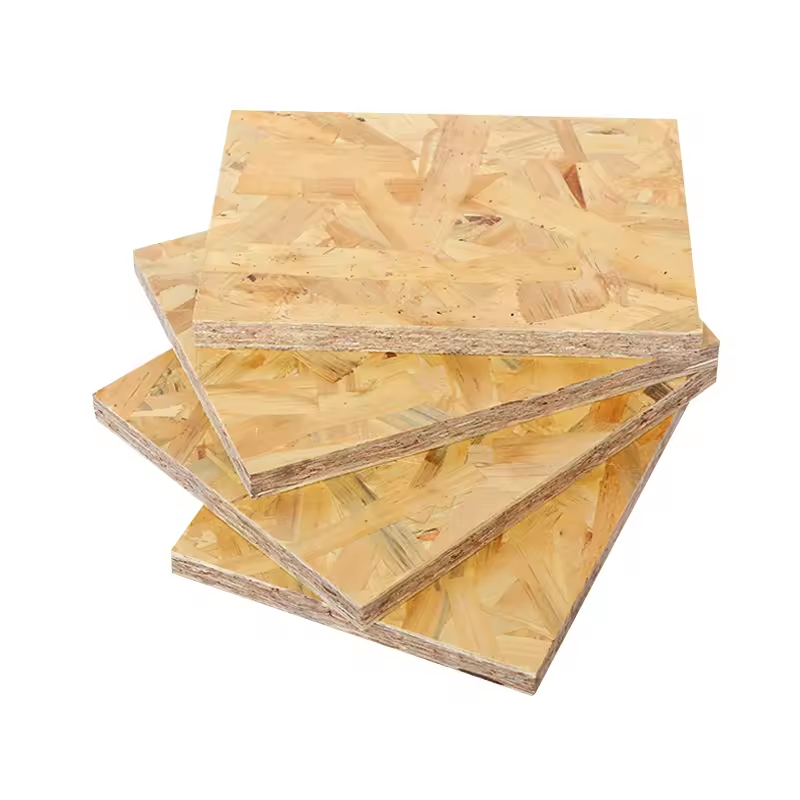
The difference between marine plywood and ordinary plywood
Marine plywood, distinct from ordinary plywood, is a high-quality, waterproof plywood.
Marine plywood refers to plywood manufactured and tested in accordance with the British Standards Institution’s BS1088 standard (the British marine plywood standard). It is commonly known in the market as marine plywood or waterproof multi-layer plywood.
Marine plywood is generally used in yachts, vehicles, ships, and outdoor wooden construction.

Differences between marine plywood and ordinary plywood:
I. Different production standards:
1. Marine plywood: Marine plywood must comply with the British BS1088 international standard, passing stringent tests such as boiling in water for 72 hours without delamination and salt spray testing.
2. Ordinary plywood: Typically conforms to the national standard GB/T 9846. The highest grade (Class I) only needs to pass a boiling in water test for 4 hours, suitable for general indoor environments.
II. Differences in Adhesives Used in Marine Plywood and Ordinary Plywood:
1. Marine Plywood: Primarily uses WPB phenolic resin adhesive (commonly known as “Tail glue” or PF glue), which is resistant to boiling water, high temperatures, and has high strength.
It meets international standards such as BS1088 and must pass a rigorous test of boiling in water for 72 hours without delamination. Its environmental protection level can reach ENF grade (≤0.05mg/m³) or Japanese F4 star. Some products use biomimetic adhesives (simulating the adhesive protein structure of mussels) to enhance water resistance.
2. Ordinary Plywood: Mostly uses urea-formaldehyde resin adhesive (UF glue), which is cheaper but not water-resistant. It is easily decomposed when exposed to moisture, and long-term use may lead to problems such as delamination and swelling. It usually only meets the standards for ordinary plywood under dry or humid conditions and cannot pass the boiling water test.
III. Differences in Core Material Used Between Marine Plywood and Ordinary Plywood:
1. Marine Plywood: Core and veneer: Primarily uses high-density, water-resistant woods such as birch, beech, lauan, and pine. Some high-end products require an full-birch plywood structure (i.e., both the core and veneer are birch).
2. Ordinary Plywood: Core and veneer: Commonly uses poplar, mixed hardwoods, core-heavy wood, or fast-growing timber. Lower cost but lower mechanical properties and water resistance.

IV. Differences in Surface Thickness Between Marine Plywood and Ordinary Plywood:
1. Marine Plywood: According to the European standard BS 1088 for marine plywood, if the plywood has more than three layers, the thickness of the wood veneer/backing veneer is 1.3 ~ 3.8 mm; if the plywood has three layers, the thickness of the wood veneer/backing veneer is approximately 0.5 mm.
2. Ordinary Plywood: To save costs, the thickness of the face/back panel can be appropriately reduced.
V. Different Uses of Marine Plywood and Ordinary Plywood:
1. Marine Plywood: Primarily used in the construction of ships or aircraft/spacecraft, it can also be used in construction or other applications as a substitute for outdoor plywood.
Shipbuilding: Marine plywood is an ideal material for ship hull construction, capable of withstanding the harsh conditions of the marine environment and maintaining the stability and safety of the hull.
Outdoor Platforms: Marine plywood used in outdoor platforms can withstand harsh environments such as wind, rain, and ultraviolet radiation, and is not easily deformed or rotten.
High-End Indoor Furniture: Due to its aesthetics and durability, marine plywood is often used to make high-end indoor furniture, such as cabinets and bathroom vanities.
Marine Engineering: In marine engineering, marine plywood is used to construct structures such as docks and breakwaters, capable of withstanding seawater erosion and wave impact.
2. Ordinary plywood is widely used in general interior decoration, furniture manufacturing, and packaging:
Interior Decoration: Plywood is commonly used for flooring, wall panels, and ceilings, offering high cost-effectiveness and easy installation.
Plywood for furniture making: Plywood is a commonly used material in furniture manufacturing, suitable for wardrobes, bookcases, bed frames, etc., offering significant cost-effectiveness.
Packaging plywood: Plywood possesses good strength and durability, often used for making shipping boxes and pallets, protecting goods.

Marine plywood and ordinary plywood differ significantly in several aspects. Marine plywood, due to its excellent durability, moisture resistance, and dimensional stability, is particularly suitable for harsh or humid environments such as ships, marine engineering, and outdoor platforms, but it is more expensive. Ordinary plywood offers high cost-effectiveness and is suitable for general interior decoration, furniture manufacturing, and packaging, but its durability and moisture resistance are inferior to marine plywood.
When purchasing plywood, users should comprehensively consider the performance, cost, and applicability of the material based on actual needs and application scenarios. If a project requires high durability and moisture resistance, marine plywood is a good choice; if the project is cost-sensitive and the environmental conditions are relatively favorable, ordinary plywood is a better option. By choosing the right plywood, project quality and results can be ensured, service life extended, and maintenance costs reduced.