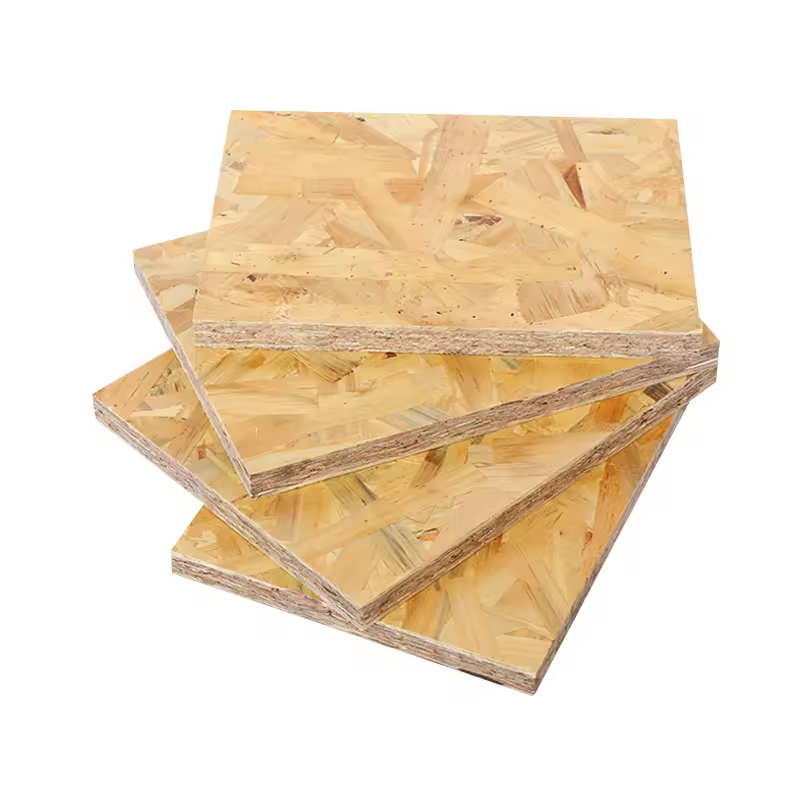
Features and Applications of Flexible Bending Plywood
Flexible bending plywood is a multi-layered wood composite material that undergoes special processing (such as thinning, grooving, softening, or pre-bending) to achieve high flexibility and maintain its curved shape stably after curing. It is specifically designed for creating small-radius arcs, spirals, and other irregularly shaped structures.
Characteristics of Flexible Bending Plywood:
1. Nature: It is not simply ordinary plywood board that has been forcibly bent. Instead, it is produced by controlling veneer thickness, adjusting adhesive properties, steam softening of lignin, or pre-pressing, giving the board the ability to undergo elastic/plastic deformation under stress without delamination or cracking.
2. Aliases: Commonly known as bent plywood, curved plywood, bentboard, shaped plywood, or “bentwood” substrate.
3. Key Indicators: It can achieve small curvature radii (some products can reach 8cm), has a low springback rate (<3%), exhibits dimensional stability after curing, and is fatigue-resistant.
The process of flexible bending plywood:
1. Structural foundation: Utilizing a multi-layered, 90° interlaced structure of thin veneers, it disperses unidirectional stress, avoiding the characteristics of traditional solid wood that easily splits along the grain and breaks across the grain.
2. Softening treatment: Softening the lignin through steam heating or chemical agents increases fiber plasticity, making it easy to reshape under pressure.
3. Oriented gluing and shaping: Applying hot or cold pressure in a mold, combined with a moisture- and heat-resistant adhesive (such as modified phenolic resin) for curing, locks in the bending shape, eliminates internal stress to prevent springback.
Advantages of flexible bending plywood:
1. Freedom of shaping: Can be cold-bent or hot-pressed into small-radius arcs, with no springback, no cracking, and a smooth surface that can be directly finished.
2. Stable performance: The multi-layered interlaced fiber structure has strong resistance to deformation, with a wood utilization rate of over 90%, and a lower cost than solid wood bent parts.
3. Convenient Construction: Large sheet size and lightweight, suitable for mechanized mass production and rapid on-site installation.

Applications of Flexible Bending Plywood:
Flexible bending plywood is mainly used in furniture manufacturing, interior decoration, and special structural applications requiring curved, spiral, or complex curved surface shapes. Its high flexibility and structural stability replace traditional solid wood bending techniques.
Core Application Areas:
1. Furniture Manufacturing: Production of bentwood chair backs/seats, curved table legs, wave-shaped coffee tables, sofa frames, and bed surrounds, balancing strength and streamlined design.
2. Interior Decoration: Used for curved stair treads/handrails, column cladding, ceiling corners, curved wall bases, and bar countertops, solving the problem of right-angle splicing marks.
3. Commercial and Public Spaces: Shopping mall entrance designs, showroom domes/curved walls, theater stage props, hotel lobby partitions, and custom restaurant table and chair sets.
4. High-end special applications: Yacht interior bulkheads, aircraft interior panels, car display stands, and foldable portable display structures, utilizing their lightweight, environmentally friendly, and easy-to-process characteristics.
5. Other fields: Vehicle interior curved surfaces, medical and rehabilitation aids, sports equipment, and packaging containers.